Knowledge journal / Edition 1 / 2022
Which restoration measures are ecologically effective?
Since the implementation of the Water Framework Directive, a large number of restoration measures have been carried out in Dutch waters to improve the ecological water quality. To what extent are these measures effective? How can we increase its success? And how can we evaluate its effects more easily? Looking for answers in available studies on the effects of restoration.
The ecological water quality in many waters is not yet at the desired level. Many restoration projects have already been carried out to enhance the status of these waters. In order to evaluate the effectiveness of the applied measures, information on the approach and implementation of the restoration projects over time is needed, as well as biological monitoring information. The Knowledge Impulse for Water Quality, Ecology section, examined what lessons can be learned about the design and monitoring of restoration projects. For 261 reports on restoration projects in the Netherlands over the period 2006-2019 the restoration outcome of measure-effect-combinations is evaluated[1].
Effectiveness measures based on evaluated reports on restoration projects
For standing waters, the majority of reports describe measures reducing the nutrient load and nature-friendly bank construction. For running waters, channel reprofiling and remeandering are common measures.
In terms of effects recorded, macroinvertebrates is the most well-studied organism group, followed by fish and aquatic plants.
Despite the large number of studies evaluated, insight into the effectiveness of the measures is limited. For each measure, contrasting effects were reported, and remarkably often no conclusion was drawn (Figure 1). However, for almost every measure there is at least one project where a positive impact has been reported. In addition, the difference in effects between projects indicates a strong context-dependence of the outcomes. Factors such as: what exactly has been done, on what spatial scale, and which other stressors play a role at a site, determine the final outcome.
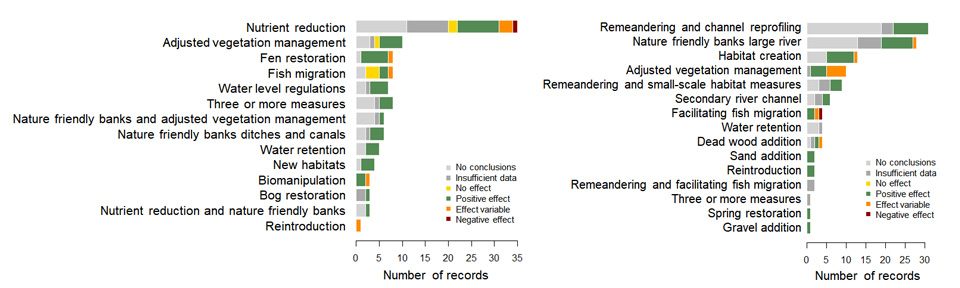 Figure 1: Evaluation of the reported effects of restoration measures in projects in the Netherlands for standing (left panel) and running (right panel) waters [1].
The inability to identify consistent effects has two main causes. Firstly, the monitoring design of many of the evaluated studies is not suitable for evaluation of the effectiveness, and secondly, statistical testing of the monitoring data is often lacking. This hinders a a well-founded effectiveness assessment.
Monitoring design
The international standard for evaluating restoration measures is the Before-After, Control-Impact (BACI) monitoring design [2]. This means measurements are needed before (before) and after (after) implementation of the measures , both at the restored location (impact site) and at a control location where no measures have been taken (control site). This approach was applied in only 9% of the cases. Incomplete BACI studies, i.e. with only a comparison of the impact location with a control (CI, 29%) or only a time series at the impact location (BA, 20%) represent a larger proportion of the cases.
Statistical testing
Reported effects were often based only on visual interpretations of, for example, graphs, while only 25% of the cases were statistically tested. None of the studies met the statistical requirements for a solid BACI study: at least three years of data before and at least four years of data after implementation of restoration measures, with consistent monitoring over the years. Figure 2 explains why this set-up is important.
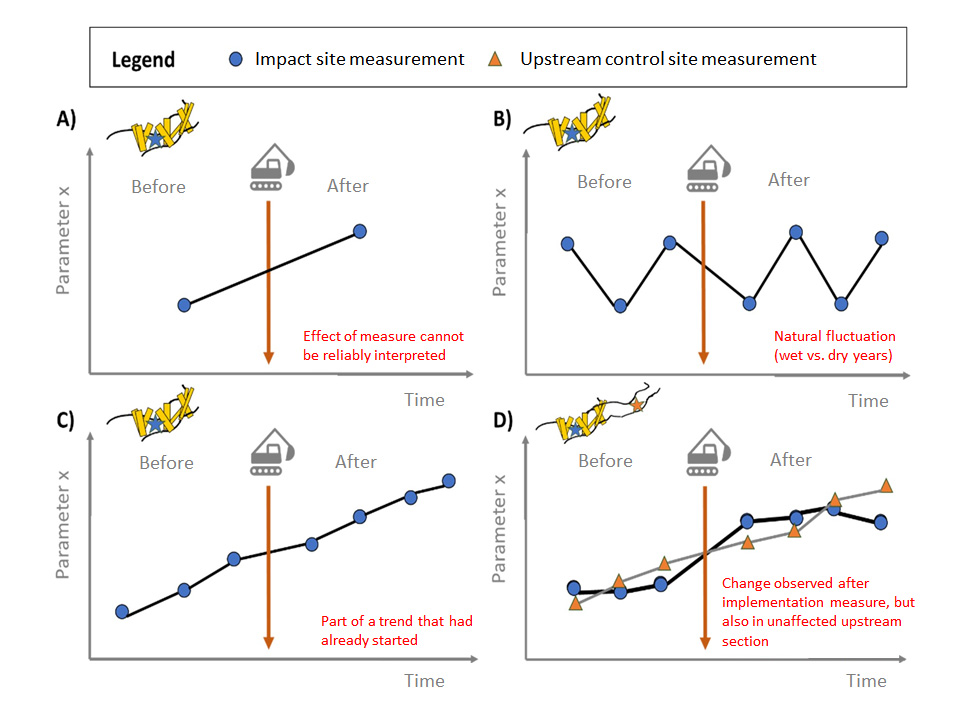 Figure 2: To determining the effects of restoration measures a BACI design is most effective, which overcomes a number of issues which might obscure the effects. This example of the application of dead woody debris in a stream shows why. When measuring only once before and once after implementation (A), the observed effectmay be part of a natural fluctuation (B), a trend already in progress (C), which may also occur upstream (triangles) where the measure has not been implemented (D)A BACI design corrects for these effects [3].
Analysis of local restoration measures
Subsequently, the effects of three types of restoration measures were determined for a subset of 40 waters for which sufficient biological data was available [3]. The effects on macrofauna of hydromorphological stream restoration and the construction of nature-friendly banks were examined, as well as the effects of nutrient-reducing measures on algal blooms.
Based on the macroinvertebrate data, no direct effects on and changes in trends in the community composition could be identified that could be traced back to the hydromorphological restoration measures carried out in the streams. Also, the difference between the macroinvertebrate communities of nature-friendly and traditional banks was not unambiguous. Algae blooms decreased due to a reduction in nutrient levels, but not to the desired level and often only temporarily.
Do the measures address all the relevant bottlenecks within the studied systems? In order to examine this, an overview was made of the bottlenecks present at the sites based on the stressors described in the fact sheets associated with the WFD river basin management plans. This analysis showed that all investigated waters were multistressed, e.g. several stressors negatively affected the waters, while the implemented measures only addressed part of these stressors. Furthermore, measures often did not target the source of the stress but only mitigated its effect.
Towards a basin-wide approach
Finally, the effectiveness of measures taken at a larger spatial scale (landscape/watershed level) was examined: what is the scope of large-scale interventions and the effect on the aquatic system [4]? In order to investigate the effectiveness of combinations of measures on a watershed scale, waters were selected where several measures had been implemented in space and time and where sufficient monitoring had been carried out as case studies.. Only four running water systems proved suitable: Tongelreep, Groote Molenbeek, Tungelroyse beek and Vlootbeek.
These cases showed an overruling effect of large-scale changes in the system on local interventions. A positive example is the general improvement in water quality through improved wastewater treatment upstream in the Tongelreep, which positively affected the results of other more local measures downstream. A negative example is the major negative impact of the 2018-summer drought on the hydromorphologically restored sections of the Vlootbeek. However, when multiple measures are taken in combination the individual effect of local single measures is often difficult to identify; it was often not possible to separate the effects of individual measures. However, in the Tongelreep, a distinct ecological recovery at the system level occurred when multiple stressors were addressed. A combination of improving the chemical water quality, large-scale re-meandering, cessation of vegetation mowing, introduction of dead woody debris and the construction of gravel beds led to a strong ecological improvement.
A watershed approach as implemented in the Tongelreep illustrates the importance of a thorough understanding of all ecologically relevant stressors in a water body. One approach to diagnose stressors on a watershed scale is the system-oriented ecological stress analysis [5]. This system analysis method quantifies biologically relevant environmental stressors on the catchment scale and relates this to the underlying causes related to the human activities within the watershed.
Conclusions
Currently it is often unclear how effective restoration measures are in the Dutch surface waters. Important reasons for this are insufficient monitoring and/or unsuitable monitoring designs. In addition, in most systems, combinations of stressors have a negative impact on the aquatic communities, whilst restoration measures often only address part of these stressors. The stream Tongelreep case study shows that when restoration measures address multiple stressors simultaneously, ecological recovery becomes visible at the system level.
Recommendations
Based on the results of the study, the following actions are recommended:
• Prior to taking measures, carry out a system-oriented ecological stress analysis (SESA) in order to quantify all relevant stressors. This provides insight into which measures should be taken to effectively improve the ecological water quality.
• Move from carrying out individual measures to implementing combinations of measures. This integrality is needed in the multi-stress context of Dutch waters, as it is the only way to simultaneously address all the bottlenecks that hinder ecological recovery. A large spatial scale is desirable here.
• Monitor the effects of restoration measures according to a BACI design instead of simply extending the time series of nearby existing biological monitoring points. This way, it is easier to determine which measures are effective (and which are not) in specific situations.
• Paying attention to cooperation and knowledge sharing. A BACI research programme is relatively labour-intensive and time-consuming, requiring a considerable investment in comparison to regular monitoring schemes However, this approach produces solid and much more generalisable results, which could therefore be used much more widely by water managers.
Ralf Verdonschot
(Wageningen Environmental Research)
Gea van der Lee
(Wageningen Environmental Research)
Jip de Vries
(Wageningen Environmental Research)
Anne-Marie van Noord
(Wageningen Environmental Research)
Annalieke Bakker
(Wageningen Environmental Research)
Piet Verdonschot
(Wageningen Environmental Research)
Background picture:
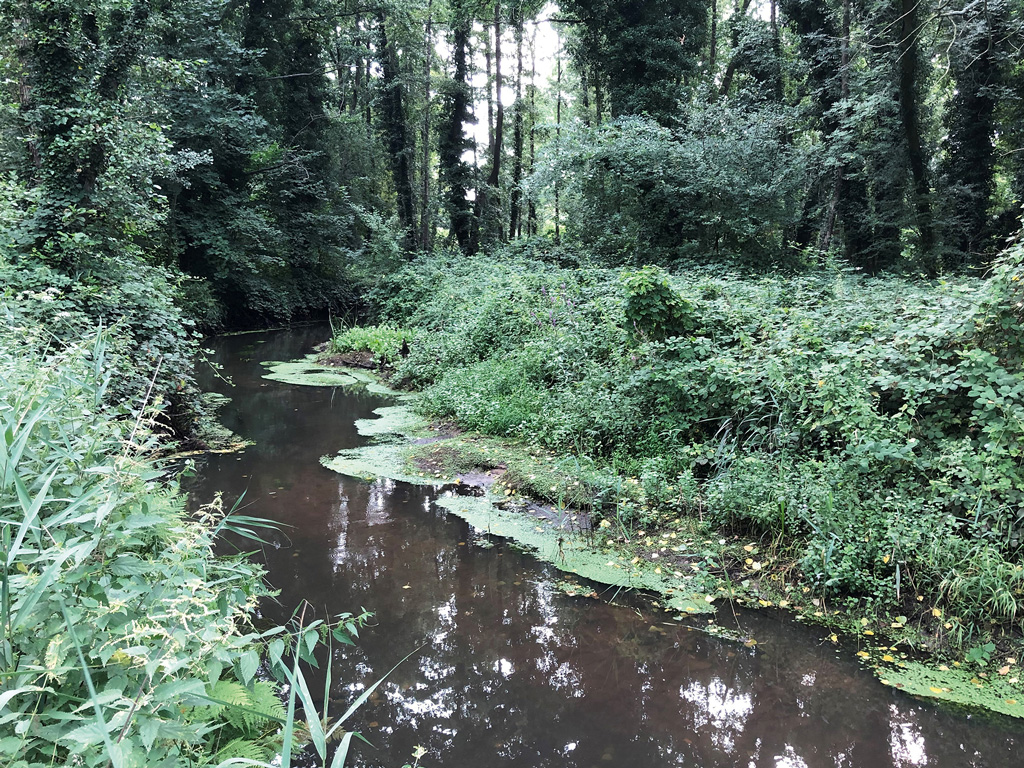
A meandering stretch of the Tongelreep in the forest with high ecological value
Summary
To improve the ecological quality of Dutch waters, many restoration projects have been carried out in recent decades. For many of these projects, it is unclear whether they have been ecologically effective, as monitoring was lacking or the design not suitable to answer this question. Also, restoration measures often only target part of the stressors present in a watershed, whilst the remaining ones hinder ecological recovery. To improve the effectiveness of the measures and to meet the ecological goals it is necessary to target all ecologically relevant stressors on a suitable spatial scale using combinations of measures. To identify these measures, a system-oriented ecological stress-analysis could be used. Furthermore, specific monitoring of the effects (before and after the intervention, at the location where measures have been taken and at a control location) is required to determine the effectiveness of the measures applied, which facilitates its implementation in future projects.
Sources
- Van Noord, A., de Vries, J., Verdonschot, P.F.M., R.C.M. (2022). Effectiveness of single measures: Evaluation of documented restoration projects in the Netherlands from 2008 to 2019. Notitie Kennisimpuls waterwaliteit (KIWK), Zoetwatererecosystemen, Wageningen Environmental Research, Wageningen UR, Wageningen.
- Underwood A.J. (1994). On Beyond BACI: Sampling designs that might reliably detect environmental disturbances. Ecological Applications 4, 3-15.
- Van der Lee G.H. Bakker, A., Verdonschot, R.C.M. and Verdonschot P.F.M. (2022). Quantification of bottlenecks and analysis of the effectiveness of remedial measures in surface waters. Notitie KIWK, Zoetwatererecosystemen, Wageningen Environmental Research, Wageningen UR, Wageningen.
- Van der Lee G.H., Bakker, A., Verdonschot R.C.M., P.F.M. (2022). Impact of local stream restoration on the ecological quality of the entire catchment area. An analysis of four river basins. Notitie Kennisimpuls waterwaliteit (KIWK), Zoetwatererecosystemen, Wageningen Environmental Research, Wageningen UR, Wageningen.
- Verdonschot P.F.M. & Verdonschot R.C.M. (2021). Ecological systems approach and ecological systems analysis. Report Knowledge Impulse Water Quality (KIWK), Freshwater Ecosystems, Wageningen Environmental Research, Wageningen UR, Wageningen.
Auteurs
Ralf Verdonschot
(Wageningen Environmental Research)

Gea van der Lee
(Wageningen Environmental Research)

Jip de Vries
(Wageningen Environmental Research)

Anne-Marie van Noord
(Wageningen Environmental Research)

Annalieke Bakker
(Wageningen Environmental Research)

Piet Verdonschot
(Wageningen Environmental Research)